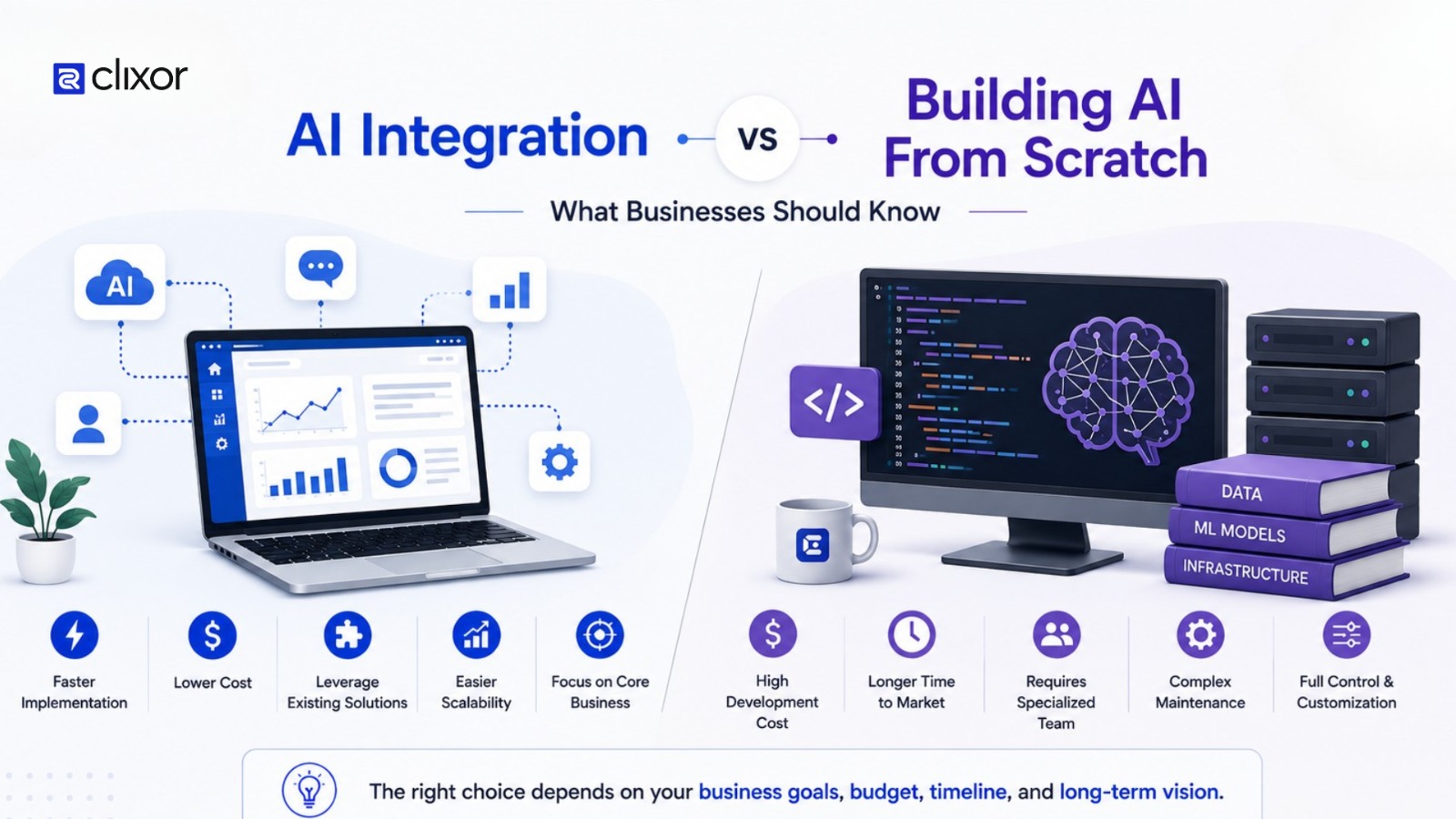
AI Integration vs Building AI From Scratch: What Businesses Should Know
AI is becoming part of everyday business operations, from customer support and document processing to analytics and automation.
But businesses do not always need to build AI from the ground up. They can integrate existing solutions into their software or develop custom systems for specific requirements.
The right choice depends on cost, business goals, data, customisation, security, and long-term needs.
- What Is AI Integration?
- What Does Building AI From Scratch Mean?
- AI Integration vs Building AI From Scratch
- When Should Businesses Choose AI Integration?
- When Is Custom AI Development Better?
- A Practical Business Example
- Common Mistakes to Avoid
- Build or Integrate: Which Is Better?
- Conclusion
What Is AI Integration?
AI integration means adding existing AI capabilities to software, websites, ERP systems, CRM platforms, or internal workflows.
Instead of building an AI model from scratch, businesses can connect existing AI services through APIs or other integration methods.
For example, an e-commerce company could integrate AI into its customer support system to answer common questions, summarise conversations, or assist employees.
The focus is on using AI effectively within existing business processes.
What Does Building AI From Scratch Mean?
Building AI from scratch means developing more of the AI system internally.
This may include:
- Preparing business data
- Designing the AI architecture
- Training or fine-tuning models
- Developing supporting software
- Testing and monitoring performance
- Managing infrastructure and maintenance
This approach offers more control but usually requires more time, expertise, and investment.
AI Integration vs Building AI From Scratch
The key difference is speed and practicality versus customisation and control.
Cost
AI integration usually requires less initial investment because businesses use existing AI infrastructure.
Custom AI development can require additional spending on developers, data preparation, infrastructure, testing, and maintenance.
Development Time
Integrating an existing AI service can be significantly faster than developing and training a custom system.
For businesses looking to test an AI use case quickly, integration can be a practical starting point.
Customization
Custom AI provides greater control over how the system works and responds.
However, many business requirements can already be handled through existing AI models, configuration, data retrieval, or fine-tuning.
Data
Custom AI often depends heavily on having sufficient, accurate, and relevant business data.
If a company lacks enough quality data, building a custom model may not deliver the expected results.
Maintenance
Integrated AI solutions can reduce some of the technical maintenance handled internally.
With custom AI, the business generally takes greater responsibility for model performance, infrastructure, security, and ongoing improvements.
When Should Businesses Choose AI Integration?
AI integration is often suitable when businesses want to:
- Automate repetitive tasks
- Improve customer support
- Add AI features to existing software.
- Analyse documents or business data.
- Generate summaries and reports.
- Test AI before making a larger investment
For example, a company can add an AI assistant to its existing CRM without developing an entire AI model.
When Is Custom AI Development Better?
Building custom AI can make more sense when existing solutions cannot meet specific requirements.
This may include:
- Specialised industry data
- Unique prediction requirements
- Proprietary datasets
- Strict model control
- Specialised performance needs
- Complex AI workflows
For example, an industrial company may need an AI model trained specifically on its own inspection images. A general-purpose AI solution may not provide the required accuracy.
A Practical Business Example
Consider a logistics company adopting AI.
It could initially integrate AI to summarise customer complaints and delivery issues. After collecting more business data, the company may discover a need for specialised prediction capabilities.
Instead of investing heavily from the outset, the company can begin with integration and move toward custom AI when a clear business requirement emerges.
Common Mistakes to Avoid
Building Custom AI Too Early
If an existing AI solution already solves the problem, developing a custom system may add unnecessary cost and complexity.
Using AI Without a Clear Goal
Businesses should start with a specific problem rather than simply looking for places to use AI.
Ask:
Which business process is slow, expensive, repetitive, or difficult to scale?
Ignoring Data Quality
AI performance depends heavily on the quality of the data being used. Businesses should evaluate their data before choosing a development approach.
Overlooking Security
AI systems may process sensitive business information. Data handling, access controls, privacy, and API security should be considered before implementation.
Build or Integrate: Which Is Better?
There is no universal answer. The best choice depends on the business problem, available AI technologies, and the level of customisation required.
Businesses can integrate an existing AI model, connect it to internal data, customise its behaviour, fine-tune a model, or eventually develop a fully custom system.
The best approach is the one that solves the business problem without adding unnecessary complexity or cost.
Conclusion
AI integration is often the practical starting point for businesses that want to adopt AI quickly and efficiently.
Custom AI development becomes more valuable when a company has specialised requirements, proprietary data, or a strong need for control.
The smartest approach is to start with the business problem, evaluate available AI technologies, and choose the level of customisation that the problem actually requires.
For Clixor Technologies, this practical approach keeps AI adoption focused on solving real business challenges rather than using AI simply because the technology is available.